Service Manuals, User Guides, Schematic Diagrams or docs for : xerox mesa 4.0_1978 listing Mesa_4_Microcode Mesa.mu_Sep78
<< Back | HomeMost service manuals and schematics are PDF files, so You will need Adobre Acrobat Reader to view : Acrobat Download Some of the files are DjVu format. Readers and resources available here : DjVu Resources
For the compressed files, most common are zip and rar. Please, extract files with Your favorite compression software ( WinZip, WinRAR ... ) before viewing. If a document has multiple parts, You should download all, before extracting.
Good luck. Repair on Your own risk. Make sure You know what You are doing.
Image preview - the first page of the document
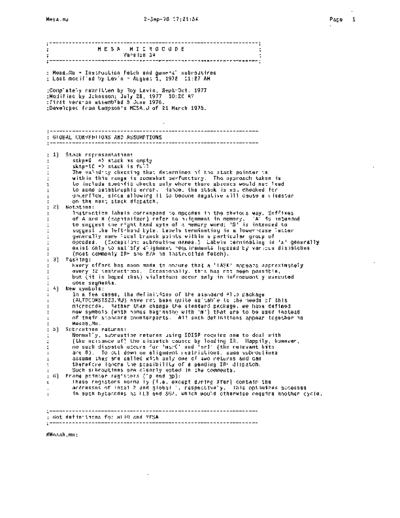
>> Download Mesa.mu_Sep78 documenatation <<
Text preview - extract from the document
Mesa.mu                                                 2-Sep-78 17:21:54                                                    Page   1


                                                                                                                         t

,                                                                                                                        ,
0   _________________________________________________________________


                              M E SAM I C ROC 0 D E
                                    Version 34
,
0   ______ - - - - - - - - - - - - - - - - - - - - - - - - - - - - - - - - - - - - - - - - - - - - - - - ____________    ,
                                                                                                                         t


; Mesa.Mu - Instruction fetch and general subroutines
; Last modified by Levin - August 1, 1978 11:27 AM
;Completely rewritten by Roy Levin, Sept-Oct. 1977
;Modified by Johnsson; July 25, 1977 10:20 AM
;First version assembl~d 5 June 1976.
;Developed from Lampson's MESA.U of 21 March 1976.


;-----------------------------------------------------------------
; GLOBAL CONVENTIONS AND ASSUMPTIONS
;-----------------------------------------------------------------
     1)     Stack representation:
               stkp=O a) stack is empty
               sktp a 10 =) stack is full
              The validity checking that determines if the stack pointer is
              within this range is somewhat perfunctory. The approach taken is
               to include specific checks only where there absence would not lead
               to some catastrophic error. Hence, the stack is not checked for
               underflow, since allowing it to become negative will cause a disaster
              on the next stack dispatch.
     2)     Notation:
               Instruction labels correspond to opcodes in the obvious way. Suffixes
              of A and B (capitalized) refer to alignment in memory. 'A' is intended
               to suggest the right-hand byte of a memory word; 'B' is intended to
               suggest the left-hand byte. Labels terminating in a lower-case letter
               generally name local branch points within a particular group of
              opcodes. (Exception: subroutine names.) Labels terminating in 'x' generally
              exist only to satisfy alignment requirements imposed by various dispatches
               (most commonly IR~ and BIA in instruction fetch).
     3)     Tasking:
              Every effort has been made to ensure that a 'TASK' appears approximately
              every 12 instructions. Occasionally, this has not been possible,
               but (it is hoped that) violations occur only in infrequently executed
              code segments.
     4)     New symbols:
               In a few cases, the definitions of the standard Alto package
               (ALTOCONSTS23.MU) have not been quite suitable to the needs of this
              microcode. Rather than change the standard package, we have defined
              new symbols (with names beginning with 'm') that are to be used instead
              of their standard counterparts. All such definitions appear together in
              Mesab.Mu.
     5)     Subroutine returns:
              Normally, subroutine returns using IDISP require one to deal with
               (the nuisance of) the dispatch caused by loading IR. Happily, however,
              no such dispatch occurs for 'msrO' and 'sr1' (the relevant bits
              are 0). To cut down on alignment restrictions, some subroutines
              assume they are called with only one of two returns and can
              therefore ignore the possibility of a pending IR~ dispatch.
              Such subroutines are clearly noted in the comments.
     6)     Frame pointer registers (lp and gp):
              These registers normally (i.e. except during Xfer) contain the
              addresses of local 2 and global 1, respectively. This optimizes accesses
               in such bytecodes as LL3 and SG2, which would otherwise require another cycle.

,
0   ______ - - - - - - - - - - - - - - - - - - - - - - - - - - - - - - - - - - - - - - - - - - - - - - - ___________ _


; Get definitions for ALTO and MESA
,
0   ______ - - - - - - - - - - - - - - - - - - - - - - - - - - - - - - - - - - - - - - - - - - - - - - - ___________ _


HMesab.mu;
Mesa.mu                            2-Sep-78 17:21:54                                              Page   2


;-----------------------------------------------------------------
; Location-specific Definitions
._----------------------------------------------------------------
,

  There is a fundamental difficulty ;n the selection of addresses that are known and
  used outside the Mesa emulator. The problem arises in trying to select a single set of
  addresses that can be used regardless of the Alto's control memory configuration. In
  effect, this cannot be done. If an Alto has only a RAM (in addition, of course, to its
  basic ROM, ROMO) , then the problem does not arise. However, suppose the Alto has both a
  RAM and a second ROM, ROM1. Th,n, when it is necessary to move from a control memory to
  one of the other two, the choice is conditioned on (1) the memory from which the transfer
  is occurring, and (2) bit 1 of the target address. Since we expect that, in most cases, an
  Alto running Mesa will have the Mesa emulator in ROM1, the externally-known addresses have
  been chosen to work in that case. They will also work, without alteration, on an Alto that
  has no ROM1. However, if it is necessary to run Mesa on an Alto with ROM1 and it is desired
  to use a Mesa emulator residing in the RAM (say, for debugging purposes), then the address
  values in the RAM version must be altered. This implies changes in both the RAM code itself
  and the Nova code that invokes the RAM (via the Nova JMPRAM instruction). Details
  concerning the necessary changes for re-assembly appear with the definitions below.
%l,1777,O,nextBa;                                      forced to location 0 to save a word in JRAM

------------------------------------------------------------------
,
  Emulator Entry Point Definitions
        These addresses are known by the Nova code that interfaces to the emulator and by
        RAM code executing with the Mesa emulator in ROM1. They have been chosen so that
        both such "users" can use the same value. Precisely, this means that bit 1 (the
        400 bit) must be set in the address. In a RAM version of the Mesa emulator intended
        to execute on an Alto with a second ROM, bit 1 must be zero.
------------------------------------------------------------------
,
%l,1777,420,Mgo;                                       Normal entry to Mesa Emulator - load state
                                                       of process specified by ACO.
%l,1777,400,next,nextA;                                Return to 'next' to continue in current Mesa
                                                       process after Nova or RAM execution.
$Minterpret        $L004400,O,O;                       Documentation refers to 'next' this way.
%l,177/,776,DSTrl,Mstopc;                              Return addresses for 'Savestate'. By
                                                       standard convention, 'Mstopc' must be at 777.
Mesa.mu                                                 2-Sep-78 17:21:54                                                                  Page   3


._----------------------------------------------------------------
◦ Jabse Service Manual Search 2026 ◦ Jabse Pravopis ◦ onTap.bg ◦ Other service manual resources online : Fixya ◦ eServiceinfo