Service Manuals, User Guides, Schematic Diagrams or docs for : . Car Manuals Acura 3.5RL 1996-2004 Approved srm RL9604S19038A
<< Back | HomeMost service manuals and schematics are PDF files, so You will need Adobre Acrobat Reader to view : Acrobat Download Some of the files are DjVu format. Readers and resources available here : DjVu Resources
For the compressed files, most common are zip and rar. Please, extract files with Your favorite compression software ( WinZip, WinRAR ... ) before viewing. If a document has multiple parts, You should download all, before extracting.
Good luck. Repair on Your own risk. Make sure You know what You are doing.
Image preview - the first page of the document
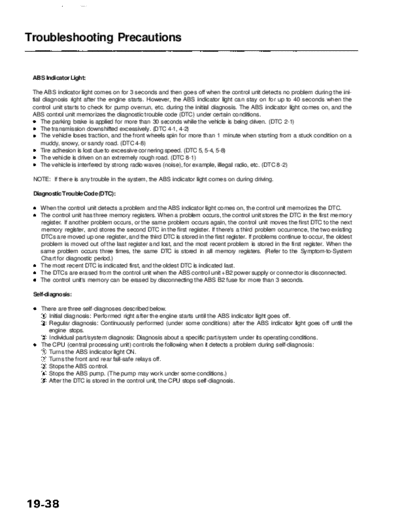
>> Download RL9604S19038A documenatation <<
Text preview - extract from the document
                   Main Menu               Table of Contents


Troubleshooting Precautions


 ABS Indicator Light:

 The ABS indicator light comes on for 3 seconds and then goes off when the control unit detects no problem during the ini-
 tial diagnosis right after the engine starts. However, the ABS indicator light can stay on for up to 40 seconds when the
 control unit starts to check for pump overrun, etc. during the initial diagnosis. The ABS indicator light comes on, and the
 ABS control unit memorizes the diagnostic trouble code (DTC) under certain conditions.
     The parking brake is applied for more than 30 seconds while the vehicle is being driven. (DTC 2-1)
     The transmission downshifted excessively. (DTC 4-1, 4-2)
     The vehicle loses traction, and the front wheels spin for more than 1 minute when starting from a stuck condition on a
     muddy, snowy, or sandy road. (DTC 4-8)
     Tire adhesion is lost due to excessive cornering speed. (DTC 5, 5-4, 5-8)
     The vehicle is driven on an extremely rough road. (DTC 8-1)
     The vehicle is interfered by strong radio waves (noise), for example, illegal radio, etc. (DTC 8-2)

 NOTE: If there is any trouble in the system, the ABS indicator light comes on during driving.

 Diagnostic Trouble Code (DTC):

    When the control unit detects a problem and the ABS indicator light comes on, the control unit memorizes the DTC.
    The control unit has three memory registers. When a problem occurs, the control unit stores the DTC in the first memory
    register. If another problem occurs, or the same problem occurs again, the control unit moves the first DTC to the next
    memory register, and stores the second DTC in the first register. If there's a third problem occurrence, the two existing
    DTCs are moved up one register, and the third DTC is stored in the first register. If problems continue to occur, the oldest
    problem is moved out of the last register and lost, and the most recent problem is stored in the first register. When the
    same problem occurs three times, the same DTC is stored in all memory registers. (Refer to the Symptom-to-System
    Chart for diagnostic period.)
    The most recent DTC is indicated first, and the oldest DTC is indicated last.
    The DTCs are erased from the control unit when the ABS control unit +B2 power supply or connector is disconnected.
    The control unit's memory can be erased by disconnecting the ABS B2 fuse for more than 3 seconds.

 Self-diagnosis:

    There are three self-diagnoses described below.
      Initial diagnosis: Performed right after the engine starts until the ABS indicator light goes off.
      Regular diagnosis: Continuously performed (under some conditions) after the ABS indicator light goes off until the
      engine stops.
      Individual part/system diagnosis: Diagnosis about a specific part/system under its operating conditions.
    The CPU (central processing unit) controls the following when it detects a problem during self-diagnosis:
      Turns the ABS indicator light ON.
      Turns the front and rear fail-safe relays off.
      Stops the ABS control.
      Stops the ABS pump. (The pump may work under some conditions.)
      After the DTC is stored in the control unit, the CPU stops self-diagnosis.
           Main Menu                Table of Contents


Kickback and Pump Operation:

  When the engine is started, the ABS control unit begins the initial diagnosis and operates the solenoid valve one time.
  The kickback may be felt when the brake pedal is pressed.
  When the ABS control unit detects the pressure switch OFF signal during the initial diagnosis, it operates the pump
  motor, and performs the pump motor over-run diagnosis and pump motor diagnosis. Therefore, there are 2 cases
  where the pump motor operates or does not operate after the engine is started.
  Normally, after the initial diagnosis, the pump motor operates based on the pressure switch signal, regardless of the
  vehicle speed.

Troubleshooting:

  When 2 or 3 DTCs are stored in the control unit, perform troubleshooting for the DTC that appears first.
  When a customer's reported problem cannot be verified on the vehicle, ask the customer about the conditions when
  the ABS indicator light came ON, and test-drive the vehicle under those conditions, if possible. When the ABS indicator
  light does not come ON during the test, check for loose terminals and check by shaking the harnesses and connectors
  while following the flowchart.
  After the repair is completed, perform the ABS function test or test-drive the vehicle, and check that the ABS indicator
  light does not come ON again during the test. (Refer to the Symptom-to-System Chart for diagnostic period.)
◦ Jabse Service Manual Search 2026 ◦ Jabse Pravopis ◦ onTap.bg ◦ Other service manual resources online : Fixya ◦ eServiceinfo