Service Manuals, User Guides, Schematic Diagrams or docs for : . Car Manuals Subaru Impreza 2001-2002.2004-2007 Approved Subaru Impreza 2004 WRX STi 08. MECHANISM AND FUNCTION 34. MANUAL TRANSMISSION AND DIFFERENTIAL (5MT) 03. Center Differential
<< Back | HomeMost service manuals and schematics are PDF files, so You will need Adobre Acrobat Reader to view : Acrobat Download Some of the files are DjVu format. Readers and resources available here : DjVu Resources
For the compressed files, most common are zip and rar. Please, extract files with Your favorite compression software ( WinZip, WinRAR ... ) before viewing. If a document has multiple parts, You should download all, before extracting.
Good luck. Repair on Your own risk. Make sure You know what You are doing.
Image preview - the first page of the document
>> Download 03. Center Differential documenatation <<
Text preview - extract from the document
W1860BE.book Page 9 Tuesday, January 28, 2003 11:01 PM


                                                               CENTER DIFFERENTIAL
                                                                                   MANUAL TRANSMISSION AND DIFFERENTIAL


           3. Center Differential
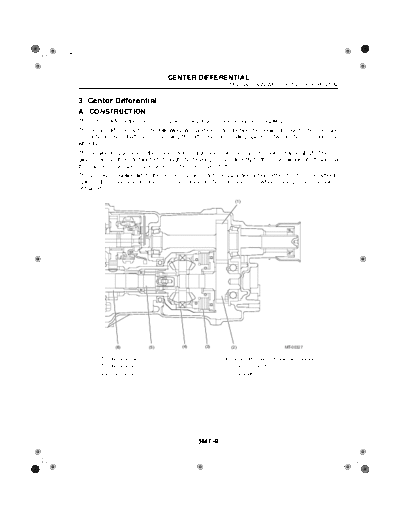
           A: CONSTRUCTION
           The center differential consists of a set of bevel gears and a viscous coupling.
           The center differential has the following two functions: distributing the engine torque to the front and
           rear wheel drive shafts and absorbing the difference in rotating speed between the front and rear
           wheels.
           The engine torque enters the center differential case from the transmission's driven shaft. The en-
           gine torque is then distributed through the bevel gear set directly to the drive pinion shaft and via
           the transfer drive and driven gears to the rear drive shaft.
           The viscous coupling limits the bevel gear set's differential action when either front or rear wheels
           spin so that adequate torques are transmitted to the front and rear wheels and proper traction is
           obtained.

                                                                                      (1)


                                  (6)                    (5)      (4)    (3)        (2)                        MT-00327

                    (1) Transfer driven gear                                    (4) Center differential (with viscous coupling)
                    (2) Transfer drive gear                                     (5) Drive pinion shaft
                    (3) Viscous coupling                                        (6) Drive shaft


                                                                        5MT-9
W1860BE.book Page 10 Tuesday, January 28, 2003 11:01 PM


                                                          CENTER DIFFERENTIAL
 MANUAL TRANSMISSION AND DIFFERENTIAL


 B: MECHANISM OF VISCOUS COUPLING
 The viscous coupling consists of a number of alternately arranged inner and outer plates and air-
 and-silicone oil mixture filled into a sealed space that is formed by the center differential case and
 the rear side gear of the differential gear set. The inner plates have their inner perimeters splined to
 the side gear and the outer plates have their outer perimeters splined to the center differential case.
 The outer plates are held apart by spacer rings. There are no spacer rings between the inner rings,
 so the inner rings are movable slightly in axial directions. X-section rings are used to prevent leak-
 age of silicone oil which would otherwise occur if the oil is pressurized due to large difference in front
 and rear axle speeds.
                                         (1)                    (2)       (3)               (4)


                                                                                      (6)              (5)


                                                               (7)                                   MT-00328

          (1) X-section ring                                                  (5) Inner plate
          (2) O-ring                                                          (6) X-section ring
          (3) Spacer ring                                                     (7) Side gear (rear)
          (4) Outer plate


                                                                     5MT-10
W1860BE.book Page 11 Tuesday, January 28, 2003 11:01 PM


                                                                CENTER DIFFERENTIAL
                                                                               MANUAL TRANSMISSION AND DIFFERENTIAL


           1. TORQUE CHARACTERISTICS
           When a speed difference occurs between the center differential case and the rear side gear, a shear
           force is generated in the silicone oil placed between the outer and inner plates. The torque is then
           transmitted by the silicone oil between the center differential case and the rear side gear.
           The greater the speed difference, the greater the shear force generated in the silicone oil. The re-
           lationship between the torque transmission and the speed difference is shown in the figure below.
           As can be seen from the figure, the smaller the speed difference, the smaller the torque transmis-
           sion and the differential action.


                                                          (A)


                                                                        (B)
                                                                                    MT-00329


                                 (A) Driving torque
                                 (B) Speed difference

           2. HUMP PHENOMENON
           Silicone oil is heated and expanded as differential action continues. This causes the pressure of air
           inside the viscous coupling to increase and the pressure of oil between plates to decrease. As a
           result, the inner and outer plates are pushed together. This direct plate-to-plate contact causes a
           non-viscous operation to occur, and this phenomenon is called "hump".
           The hump eliminates the rotating speed difference between the center differential case and the rear
           side gear (or locks the differential), so soon after it has occurred, the internal pressure and temper-
           ature drop. The viscous coupling then returns to the normal shear torque transmitting operation.
           (The hump phenomenon does not occur under normal operating conditions.)


                                                                      5MT-11
W1860BE.book Page 12 Tuesday, January 28, 2003 11:01 PM


                                                          CENTER DIFFERENTIAL
 MANUAL TRANSMISSION AND DIFFERENTIAL


 C: FUNCTION
 When there is no speed difference between the front and rear wheels, the center differential delivers
 the engine torque to the front and rear wheels at a ratio of 50:50.
 When a rotating speed difference occurs between the front and rear wheels, the center differential
 operates to absorb it in a controlled way by the function of the viscous coupling.
 1. DURING NORMAL DRIVING
 During straight-line driving on a flat road at a constant speed, all the four wheels rotate at the same
 speed. The center differential delivers engine torque evenly to the front and rear wheels. The vis-
 cous coupling does not generate shear torque because there is no relative movements between the
 inner and outer plates.


                                                                                       (B)


                                                          (1)


                                  (A)


                                                                                         MT-00330

      (1) Engine torque                                    (A) To front differential   (B) To rear differential


                                                                        5MT-12
W1860BE.book Page 13 Tuesday, January 28, 2003 11:01 PM


                                                          CENTER DIFFERENTIAL
                                                                         MANUAL TRANSMISSION AND DIFFERENTIAL


           2. DURING TURNS AT LOW SPEEDS
           During turns at low speeds, rotating speed difference occurs between the front and rear wheels, as
           well as between the left and right wheels. More particularly, the front wheels rotate faster than the
           rear wheels. The center differential then acts to absorb the speed difference to enable smooth driv-
           ing.
           Although the speed difference is small under this condition, operation of the viscous coupling caus-
           es more torque to be transmitted to the rear than to the front.


                                                                                   MT-00331


                                                                5MT-13
W1860BE.book Page 14 Tuesday, January 28, 2003 11:01 PM


                                                          CENTER DIFFERENTIAL
 MANUAL TRANSMISSION AND DIFFERENTIAL


 3. DRIVING ON ROUGH OR SLIPPERY ROADS
   When front wheels are on a slippery surface
 When the front wheels begin to spin, the resulting speed difference between the front and rear drive
 shafts causes the viscous coupling to generate significant amount of shear torque. As a result, the
 torque distributed to the rear wheels becomes much larger than that distributed to the spinning front
 wheels. The traction and driving stability are thus ensured on a rough or slippery road.


                                                                                MT-00332

    When rear wheels are on a slippery surface
 When the vehicle is accelerated quickly from a standing start with the rear wheels on a slippery sur-
 face, the distribution of the vehicle weight on the front and rear wheels changes and the rear wheels
 start spinning. Due to the resulting speed difference between the front and rear drive shafts, the vis-
 cous coupling generates a significant amount of shear torque, now in the direction opposite to that
 generated when the front wheels are on a slippery surface. As a result, the torque distributed to the
 front wheels becomes much larger than that distributed to the rear wheels.


                                                                                MT-00333


                                                                5MT-14
◦ Jabse Service Manual Search 2026 ◦ Jabse Pravopis ◦ onTap.bg ◦ Other service manual resources online : Fixya ◦ eServiceinfo