Service Manuals, User Guides, Schematic Diagrams or docs for : . Car Manuals Subaru Legacy 1995-1999 Approved Subaru Legacy 1997 1997 Service Manual MECHANICAL COMPONENTS SECTION AIR CONDITIONING SYSTEM MSA5TCD97L3746
<< Back | HomeMost service manuals and schematics are PDF files, so You will need Adobre Acrobat Reader to view : Acrobat Download Some of the files are DjVu format. Readers and resources available here : DjVu Resources
For the compressed files, most common are zip and rar. Please, extract files with Your favorite compression software ( WinZip, WinRAR ... ) before viewing. If a document has multiple parts, You should download all, before extracting.
Good luck. Repair on Your own risk. Make sure You know what You are doing.
Image preview - the first page of the document
>> Download MSA5TCD97L3746 documenatation <<
Text preview - extract from the document
  SERVICE PROCEDURE                                                4-7
                                                          8. Leak Testing


          8. Leak Testing
          The following points should be kept in mind when conduct-
          ing a refrigerant leak test.
          1) The A/C system to be tested must have an adequate
          refrigerant charge to begin with.
          2) The area where the leak test is conducted must be free
          of wind and drafts, with still air being the ideal condition.
          3) The atmosphere where the leak test is conducted must
          be free of refrigerant contamination.
          4) Operate the A/C system for approx. 10 minutes, then
          turn the engine off an begin the leak test.
          5) Refrigerant gas is heavier than air, therefore always
          hold the probe below the connection being tested.
          6) When checking for a leak along a length of hose or
          tube, the leak detector probe must be moved slowly,
          approx. 25 mm (1 in) per second making sure probe does
          not come in contact with the component being tested.
          7) When checking for a leak at a certain point, the leak
          detector probe must be held at that point for at least 5
          seconds.

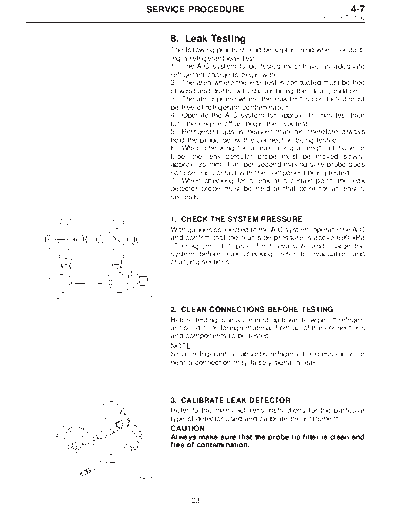
          1. CHECK THE SYSTEM PRESSURE
          With gauges connected to the A/C system, operate the A/C
          and confirm that the high side pressure is above 690 kPa
          (7.03 kg/cm2, 100 psi). If not, evacuate and charge the
          system before leak checking (refer to evacuation and
          charging sections).


G4M0609


          2. CLEAN CONNECTIONS BEFORE TESTING
          Before testing, use a clean shop towel to wipe off refriger-
          ant oil, dirt, or foreign material from all of the connections
          and components to be tested.
          NOTE:
          Since refrigerant oil absorbs refrigerant, excess oil on or
          near a connection may falsely signal a leak.


          3. CALIBRATE LEAK DETECTOR
          Refer to the manufacturer's instructions for the particular
          type of detector used and calibrate the instrument.
          CAUTION:
          Always make sure that the probe tip filter is clean and
          free of contamination.


B4M0089


                23
4-7                 SERVICE PROCEDURE
8. Leak Testing


                            4. LEAK TEST -- HIGH-PRESSURE SIDE
                            Operate the A/C system for approx. 10 minutes, then turn
                            the engine off and begin the leak test.
                            1) Begin at the connection of the high-pressure tube to the
                            evaporator, and work your way along the high- pressure
                            side of the system to the compressor. There are three
                            places to check on each tube connection.
                            2) Check the area.
                                (1) Check the area where the fitting joins the tube.
                  G4M0612


                               (2) Check the area where the two parts of the fitting
                               join each other.


                  G4M0613


                               (3) Check the area where the nut joins the tube.


                  G4M0614


                            3) Check the area of the sight glass and pressure switch
                            (dual switch), and also check the seams of the receiver
                            drier.
                            4) Check the connections of the tubes to the condenser,
                            and also check any welded joints on the condenser.
                            CAUTION:
                            An oily area on the fins of the condenser may indicate
                            a leak.
                            5) Check the area where the hoses attach to the compres-
                            sor.
                            6) Check around the machined portions of the compressor
                            (where the compressor sections join each other).
                            7) If equipped, check the thermal limiter on the compres-
                            sor housing.
                            8) Check the compressor shaft seal by probing near the
                            center of the compressor clutch pulley.
                            NOTE:
                            Some shaft seals have a very slight amount of normal
                            leakage [approximately 28 g (1.0 oz) per year].


                                  24
  SERVICE PROCEDURE                                                4-7
                                                          8. Leak Testing


          5. LEAK TEST -- LOW-PRESSURE SIDE
          1) Begin at the connection of the low-pressure tube to the
          evaporator, and work your way along the low-pressure of
          the system to the compressor. There are three places to
          check on each tube connection.
          2) Check the area.
             (1) Check the area where the fitting joins the tube.
             (2) Check the area where the two parts of the fitting
             join each other.
G4M0615


             (3) Check the area where the nut joins the tube.


G4M0616

          6. CHECK THE FLEXIBLE HOSES
          Visually inspect the rubber portions of the flexible hoses for
          cracking. Probe the rubber section, including the ends of
          any insulators or protectors which may cover sections of
          the rubber hose, and near the ends where the rubber
          meets the metal collar.
          NOTE:
          Be certain to move the probe slowly [approximately 25 mm
          (1 in) per second] when probing along any length of hose
G4M0617   or tube.
          7. CHECK THE EVAPORATOR ASSEMBLY
          1) Use one or both of the following methods to check the
          evaporator assembly.
          2) Remove the drain hose from the case drain nipple. Hold
          the probe at the end of the case drain nipple for at least 10
          seconds. Be certain to reconnect the drain hose when fin-
          ished.
          3) With the ignition key in the "ACC" position, run the
          blower on high speed for 1 minute, then turn the blower off.
G4M0618   Place the probe in the center instrument panel vent, an turn
          the blower on low speed for 1 to 2 seconds, then turn the
          blower off. Leave the probe in the vent for at least 10 sec-
          onds.


                25
4-7                                  SERVICE PROCEDURE
8. Leak Testing - 9. Lubrication


                                             8. CHECK THE SERVICE PORT CAPS
                                             Visually inspect the inside of the service port caps. Make
                                             sure the rubber seal is in place on the inside of the caps.
                                             Disconnect the gauges from the vehicle and install the
                                             service port caps.


                                   G4M0619


                                             9. Lubrication
                                             1. SYSTEM OIL STABILIZATION
                                             Prior to opening the refrigerant system for repairs (except
                                             compressor seizure) the system must be stabilized for cor-
                                             rect oil replenishment.
                                             Follow these procedures:
                                             1) Engine speed set to 1,500 rpm
                                             2) A/C "ON"
                                             3) Air source to recirculate
                                             4) Blower in 4th or high speed position
◦ Jabse Service Manual Search 2026 ◦ Jabse Pravopis ◦ onTap.bg ◦ Other service manual resources online : Fixya ◦ eServiceinfo