Service Manuals, User Guides, Schematic Diagrams or docs for : . Car Manuals Subaru Legacy 1995-1999 Approved Subaru Legacy 1998 1998 Service Manual DIAGNOSTICS SECTION AUTOMATIC TRANSMISSION AND DIFFERENTIAL MSA5TCD98L21333
<< Back | HomeMost service manuals and schematics are PDF files, so You will need Adobre Acrobat Reader to view : Acrobat Download Some of the files are DjVu format. Readers and resources available here : DjVu Resources
For the compressed files, most common are zip and rar. Please, extract files with Your favorite compression software ( WinZip, WinRAR ... ) before viewing. If a document has multiple parts, You should download all, before extracting.
Good luck. Repair on Your own risk. Make sure You know what You are doing.
Image preview - the first page of the document
>> Download MSA5TCD98L21333 documenatation <<
Text preview - extract from the document
AUTOMATIC TRANSMISSION AND DIFFERENTIAL [T1000] 3-2
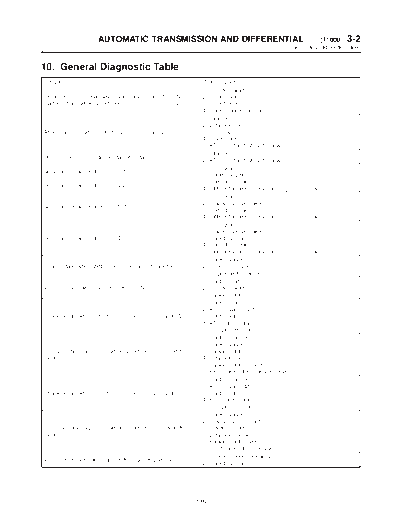
10. General Diagnostic Table
10. General Diagnostic Table
Symptom Problem parts
1) Inhibitor switch
Starter does not rotate when select lever is in "P" or "N"; 2) Select cable
starter rotates when select lever is in "R", "D", "3" or "2". 3) Select lever
4) Starter motor and harness
1) Strainer
2) Duty solenoid C
Abnormal noise when select lever is in "P" or "N". 3) Oil pump
4) Drive plate
5) ATF level too high or too low
1) Strainer
Hissing noise occurs during standing start.
2) ATF level too high or too low
1) Final gear
Noise occurs while driving in "D1".
2) Planetary gear
3) Reduction gear
Noise occurs while driving in "D2".
4) Differential gear oil level too high or too low
1) Final gear
2) Low & reverse brake
Noise occurs while driving in "D3".
3) Reduction gear
4) Differential gear oil level too high or too low
1) Final gear
2) Low & reverse brake
Noise occurs while driving in "D4". 3) Planetary gear
4) Reduction gear
5) Differential gear oil level too high or too low
1) Control valve
Engine stalls while shifting from one range to another. 2) Lock-up damper
3) Engine performance
1) Control module
Vehicle moves when select lever is in "N". 2) Inhibitor switch
3) Forward clutch
1) Control module
2) Accumulator ("N" to "D")
Shock occurs when select lever is moved from "N" to "D". 3) Control valve
4) ATF deterioration
5) Dropping resistor
1) Control module
2) Control valve
Excessive time lag occurs when select lever is moved from 3) Forward clutch
"N" to "D". 4) Duty solenoid A
5) Forward clutch seal ring
6) Front gasket transmission case
1) Control module
2) Accumulator (4A)
Shock occurs when select lever is moved from "N" to "R". 3) Control valve
4) ATF deterioration
5) Dropping resistor
1) Control valve
2) Low & reverse clutch
Excessive time lag occurs when select lever is moved from 3) Reverse clutch
"N" to "R". 4) Duty solenoid A
5) Forward clutch seal ring
6) Front gasket transmission case
1) Parking brake mechanism
Vehicle does not start in any shift range (engine stalls).
2) Planetary gear
135
3-2 [T1000] AUTOMATIC TRANSMISSION AND DIFFERENTIAL
10. General Diagnostic Table
Symptom Problem parts
1) Strainer
2) Duty solenoid A
3) Control valve
4) Drive pinion
5) Hypoid gear
6) Axle shaft
7) Differential gear
Vehicle does not start in any shift range (engine revving up).
8) Oil pump
9) Input shaft
10) Output shaft
11) Planetary gear
12) Drive plate
13) ATF level too low
14) Front gasket transmission case
1) Select cable
2) Select lever
Vehicle does not start in "R" range only (engine revving up). 3) Control valve
4) Low & reverse clutch
5) Reverse clutch
1) Forward clutch
2) Band brake
Vehicle does not start in "R" range only (engine stalls).
3) Planetary gear
4) Parking brake mechanism
Vehicle does not start in "D", "3" or "2" range only (engine rev- 1) Forward clutch
ving up). 2) One-way clutch (1-2)
Vehicle does not start in "D", "3", "2" or "1" range only (engine
1) Forward clutch
revving up).
Vehicle does not start in "D", "3", "2" or "1" range only (engine
1) Reverse clutch
stalls).
Vehicle starts in "R" range only (engine revving up). 1) Control valve
1) Control valve
2) Forward clutch
Acceleration during standing starts is poor (high stall rpm). 3) Reverse clutch
4) ATF level too low
5) Front gasket transmission case
1) Oil pump
Acceleration during standing starts is poor (low stall rpm). 2) Torque converter one-way clutch
3) Engine performance
1) Control module
2) Control valve
Acceleration is poor when select lever is in "D", "3" or "2"
3) High clutch
range (normal stall rpm).
4) Brake band
5) Planetary gear
1) Control module
2) Overrunning clutch
Acceleration is poor when select lever is in "R" (normal stall
3) High clutch
rpm).
4) Brake band
5) Planetary gear
1) Control module
2) Vehicle speed sensor 1
3) Vehicle speed sensor 2
4) Throttle position sensor
No shift occurs from 1st to 2nd gear.
5) Shift solenoid 1
6) Shift solenoid 2
7) Control valve
8) Brake band
136
AUTOMATIC TRANSMISSION AND DIFFERENTIAL [T1000] 3-2
10. General Diagnostic Table
Symptom Problem parts
1) Control module
2) Control valve
No shift occurs from 2nd to 3rd gear.
3) High clutch
4) One-way clutch (3-4)
1) Control module
2) Accumulator (3R)
No shift occurs from 3rd to 4th gear. 3) ATF temperature sensor
4) Control valve
5) Band brake
1) Inhibitor switch
2) Control module
Engine brake is not effected when select lever is in "3" range. 3) Throttle position sensor
4) Control valve
5) Shift solenoid 3
Engine brake is not effected when select lever is in "3" or "2" 1) Control valve
range. 2) Overrunning clutch
1) Control valve
Engine brake is not effected when select lever is in "1" range.
2) Low & reverse brake clutch
1) Inhibitor switch
2) Control module
3) Vehicle speed sensor 1
Shift characteristics are erroneous.
4) Vehicle speed sensor 2
5) Throttle position sensor
6) Control valve
1) Control module
2) Throttle position sensor
3) ATF temperature sensor
No lock-up occurs.
4) Control valve
5) Lock-up facing
6) Engine speed signal
Parking brake is not effected. 1) Select cable
Shift lever cannot be moved or is hard to move from "P" 2) Select lever
range. 3) Parking mechanism
ATF spurts out. 1) ATF level too high
Differential oil spurts out. 1) Differential gear oil too high
1) Seal pipe
Differential oil level changes excessively.
2) Double oil seal
1) Transfer clutch
2) Forward clutch
3) Overrunning clutch
4) High clutch
Odor is produced from ATF supply pipe. 5) Band brake
6) Low & reverse clutch
7) Reverse clutch
8) Lock-up facing
9) ATF deterioration
1) Control module
2) Throttle position sensor
3) Accumulator (2A)
4) ATF temperature sensor
5) Duty solenoid A
Shock occurs from 1st to 2nd gear.
6) Control valve
7) Band brake
8) ATF deterioration
9) Engine performance
10) Dropping resistor
137
3-2 [T1000] AUTOMATIC TRANSMISSION AND DIFFERENTIAL
10. General Diagnostic Table
Symptom Problem parts
1) Control module
2) Throttle position sensor
3) Accumulator (2A)
Slippage occurs from 1st to 2nd gear. 4) ATF temperature sensor
5) Duty solenoid A
6) Control valve
7) Band brake
1) Control module
2) Throttle position sensor
3) Accumulator (3R)
4) ATF temperature sensor
5) Duty solenoid A
Shock occurs from 2nd to 3rd gear. 6) Control valve
7) High clutch
8) Band brake
9) ATF deterioration
10) Engine performance
11) Dropping resistor
1) Control module
2) Throttle position sensor
3) Accumulator (3R)
4) ATF temperature sensor
Slippage occurs from 2nd to 3rd gear.
5) Duty solenoid A
6) Control valve
7) High clutch
8) Band brake
1) Control module
2) Throttle position sensor
3) Accumulator
4) ATF temperature sensor
5) Duty solenoid A
Shock occurs from 3rd to 4th gear.
6) Control valve
7) Overrunning clutch
8) Band brake
9) ATF deterioration
10) Engine performance
1) Control module
2) Throttle position sensor
3) Accumulator
Slippage occurs from 3rd to 4th gear. 4) ATF temperature sensor
5) Duty solenoid A
6) Control valve
7) Band brake
1) Control module
2) Throttle position sensor
3) ATF temperature sensor
Shock occurs when select lever is moved from "3" to "2" 4) Duty solenoid A
range. 5) Control valve
6) Overrunning clutch
7) Band brake
8) ATF deterioration
1) Control module
2) Throttle position sensor
3) ATF temperature sensor
Shock occurs when select lever is moved from "D" to "1"
4) Duty solenoid A
range.
5) Control valve
6) ATF deterioration
7) Low & reverse brake
138
AUTOMATIC TRANSMISSION AND DIFFERENTIAL [T1000] 3-2
10. General Diagnostic Table
Symptom Problem parts
1) Control module
2) Throttle position sensor
3) ATF temperature sensor
Shock occurs when select lever is moved from "2" to "1"
4) Duty solenoid A
range.
5) Control valve
6) Low & reverse clutch
7) ATF deterioration
1) Control module
2) Throttle position sensor
3) ATF temperature sensor
Shock occurs when accelerator pedal is released at medium
4) Duty solenoid A
speeds.
5) Control valve
6) Lock-up damper
7) Engine performance
1) Control module
2) Duty solenoid B
Vibration occurs during straight-forward operation.
3) Lock-up facing
4) Lock-up damper
1) Control module
2) Vehicle speed sensor 1
3) Vehicle speed sensor 2
4) Throttle position sensor
Vibration occurs during turns (tight corner "braking" phenom-
5) ATF temperature sensor
enon).
6) Transfer clutch
7) Transfer valve
8) Duty solenoid C
9) ATF deterioration
1) Control module
2) Vehicle speed sensor 2
3) FWD switch
4) Throttle position sensor
5) ATF temperature sensor
Front wheel slippage occurs during standing starts. 6) Control valve
7) Transfer clutch
8) Transfer valve
9) Transfer pipe
10) Duty solenoid C
11) Transfer clutch hub
1) Control module
2) FWD switch
Vehicle is not set in FWD mode. 3) Transfer clutch
4) Transfer valve
5) Duty solenoid C
1) Select cable
2) Select lever
Select lever is hard to move.
3) Detent spring
4) Manual plate
1) Detent spring
Select lever is too high to move (unreasonable resistance).
2) Manual plate
1) Select cable
Select lever slips out of operation during acceleration or while 2) Select lever
driving on rough terrain. 3) Detent spring
4) Manual plate
139
3-2 AUTOMATIC TRANSMISSION AND DIFFERENTIAL
MEMO:
140
◦ Jabse Service Manual Search 2026 ◦ Jabse Pravopis ◦ onTap.bg ◦ Other service manual resources online : Fixya ◦ eServiceinfo