Service Manuals, User Guides, Schematic Diagrams or docs for : . Car Manuals Toyota Camry 1994.2002-2007 Approved Toyota Camry 2007 Hybrid 50 introduc generalr
<< Back | HomeMost service manuals and schematics are PDF files, so You will need Adobre Acrobat Reader to view : Acrobat Download Some of the files are DjVu format. Readers and resources available here : DjVu Resources
For the compressed files, most common are zip and rar. Please, extract files with Your favorite compression software ( WinZip, WinRAR ... ) before viewing. If a document has multiple parts, You should download all, before extracting.
Good luck. Repair on Your own risk. Make sure You know what You are doing.
Image preview - the first page of the document
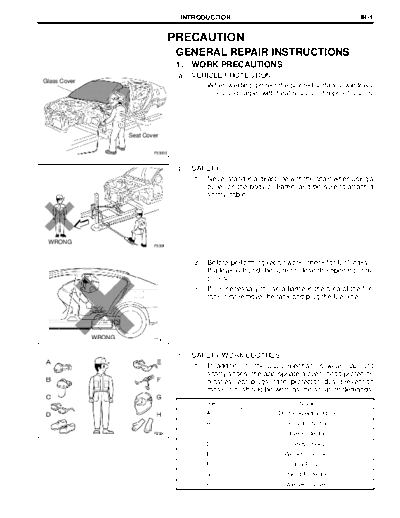
>> Download generalr documenatation <<
Text preview - extract from the document
INTRODUCTION IN-1
PRECAUTION
GENERAL REPAIR INSTRUCTIONS
1. WORK PRECAUTIONS
(a) VEHICLE PROTECTION
Glass Cover
(1) When welding, protect the painted surfaces, windows,
seats and carpet with heat resistant, fireproof covers.
Seat Cover
F33000
(b) SAFETY
(1) Never stand in a direct line with the chain when using a
puller on the body or frame, and be sure to attach a
safety cable.
WRONG
F33001
(2) Before performing repair work, check for fuel leaks.
If a leak is found, be sure to close the opening com-
pletely.
(3) If it is necessary to use a flame in the area of the fuel
tank, first remove the tank and plug the fuel line.
WRONG F33002
(c) SAFETY WORK CLOTHES
(1) In addition to the usual mechanic's wear, cap and
safety shoes, the appropriate gloves, head protector,
glasses, ear plugs, face protector, dust-prevention
mask, etc. should be worn as the situation demands.
Code Name
A Dust-Prevention Mask
B Face Protector
F33003 C Eye Protector
D Safety Shoes
E Welder's Glasses
F Ear Plugs
G Head Protector
H Welder's Gloves
IN-2 INTRODUCTION
2. PRECAUTIONS FOR HIGH-VOLTAGE CIRCUIT
INSPECTION AND SERVICE
NOTICE:
The CAMRY HV hybrid system contains a 288V high-volt-
age system with a strong alkali solution of potassium hy-
droxide. Be sure to follow the instructions in this manual to
handle the system correctly. Failure to do so may result in
serious injury or electrocution.
(a) Engineer must undergo special training to be able to per-
form high-voltage system inspection and servicing.
(b) All high-voltage wire harness connectors are colored
orange. The HV battery and other high-voltage compo-
nents have "High Voltage" caution labels. Do not carelessly
touch these wires and components.
(c) Before inspecting or servicing the high-voltage system, be
sure to follow safety measures, such as wearing insulated
gloves and removing the service plug to prevent electrocu-
tion. Carry the removed service plug in your pocket to pre-
vent other technicians from reinstalling it while you are
servicing the vehicle.
A142844
NOTICE:
Do not put the vehicle into the READY-on state after remov-
ing the service plug grip as the ECU may be damaged.
(d) After removing the service plug, wait 5 minutes before
touching any of the high-voltage connectors and terminals.
HINT:
5 minutes are required to discharge the high-voltage con-
denser inside the inverter.
INTRODUCTION IN-3
(e) Before wearing insulated gloves, make sure that they are
DO NOT WEAR not cracked, ruptured, torn, or damaged in any way. Do not
wear wet insulated gloves.
(f) When servicing the vehicle, do not carry metal objects like
mechanical pencils or scales that can be dropped acciden-
tally and cause a short circuit.
(g) Before touching a bare high-voltage terminal, wear insu-
lated gloves and use a tester to make sure that the terminal
voltage 0 V.
B076060E01
(h) After disconnecting or exposing a high-voltage connector
or terminal, insulate it immediately using insulation tape.
(i) The screw of a high-voltage terminal should be tightened
firmly to the specified torque. Both insufficient and exces-
sive torque can cause failure.
(j) Use the "CAUTION: HIGH VOLTAGE. DO NOT TOUCH
DURING OPERATION" sign to notify other engineers that a
high-voltage system is being inspected and/or repaired.
D100236
(k) After servicing the high-voltage system and before reinstal-
ling the service plug, check again that you have not left a
part or tool inside, that the high-voltage terminal screws are
firmly tightened, and that the connectors are correctly con-
nected.
(l) Do not place the battery upside down while removing and
installing it.
IN-4 INTRODUCTION
CAUTION:
HIGH VOLTAGE. DO
NOT TOUCH DURING
OPERATION.
Person in charge:
Copy this page and put it after folding on the roof of the vehicle in service.
B075514E01
INTRODUCTION IN-5
3. ACTIONS TO BE TAKEN FOR VEHICLE
DAMAGED BY IMPACT
NOTICE:
The CAMRY HV hybrid system contains a 288 V high-volt-
age system with a strong alkali solution of potassium hy-
droxide. Be sure to follow the instructions in this manual to
handle the system correctly. Failure to do so may result in
serious injury or electrocution.
(a) Items to be prepared or operation at the accident site
D Protective clothing (insulated gloves, rubber gloves,
goggles, and safety shoes)
D Saturated boric acid solution 20 L (obtain 800 g of bo-
ric acid powder, put it into a container, and dissolve it in
water)
D Red litmus paper
D ABC fire extinguisher (effective against both oil flames
and electrical flames)
D A shop rag or piece of cloth (for wiping off the electro-
lyte)
D Insulation tape (for insulating cable)
D Electrical tester
(b) Actions to be taken at the accident site
NOTICE:
Do not touch a bare cable that may have high-voltage.
If the cable must be touched or if accidental contract is
unavoidable, wear insulated gloves and insulate the
cable using insulation tape.
D If the vehicle catches on fire, use an ABC fire extin-
guisher to extinguish the fire. Trying to extinguish a fire
using only a small amount of water can be more dan-
gerous than effective. Use a substantial amount of wa-
ter or wait for firefighters.
D Visually check the HV battery and the immediate area
for any electrolyte leakage. Do not touch any leaked
liquid because it could be highly alkaline electrolyte.
D Work on the vehicle only after the vehicle has been
pulled out of the water.
(1) Check the vicinity of the hybrid vehicle battery for any
leakage of the electrolyte.
NOTICE:
Do not touch any leaked liquid because it could be
highly alkaline electrolyte. Wear rubber gloves
and goggles, neutralize the liquid with saturated
boric acid solution, and then apply red litmus pa-
per to the leak. Check that the paper does not turn
blue. Wipe the neutralized liquid with a shop rag or
piece of cloth.
(2) If damage to any of the high-voltage components and
cable is suspected, cut the high-voltage circuit using
the procedure on the following pages.
IN-6 INTRODUCTION
CRANKSHAFT POSITION SENSOR AUXILIARY BATTERY
- BATTERY TEMPERATURE
SENSOR
HYBRID VEHICLE CONTROL ECU
HV BATTERY
FRAME WIRE
ENGINE ROOM R / B NO. 1
WATER PUMP WITH MOTOR &
BRACKET ASSEMBLY
DC / DC
IGCT FUSE
WITH MOTOR COMPRESSOR
ASSEMBLY
INV W / P FUSE
IGCT No. 2
IGCT RELAY
IG2 RELAY
A142561
INTRODUCTION IN-7
(3) Turn the power switch off.
HINT:
If the power switch cannot be turned off, remove the
IGCT fuse from the engine room R/B No. 1 or discon-
nect the cable from the negative terminal of the auxil-
IGCT Fuse iary battery.
(4) Wear insulated gloves, and then remove the service
plug.
NOTICE:
Be sure to install the service plug before turning
on (IG) the power switch. Starting the hybrid sys-
tem with the service plug removed may damage
the ECU.
(c) Moving the damaged vehicle
D101369 If any of the following conditions are met, tow the vehicle
away using a tow truck.
D One or more of the high-voltage components and
cables are damaged.
D The driving, traction, or fuel system is damaged.
D The master warning light is on.
D The READY light does not come on when the vehicle
is in the READY-on state.
CAUTION:
D Before towing the vehicle away using a tow
truck, disconnect the cable from the negative
(-) terminal of the auxiliary battery and re-
move the service plug.
NOTICE:
Perform the procedure below if the READY light turns
off, or there are abnormal noises, unusual smells, or
D101364 strong vibrations while driving:
(1) Park the vehicle in a safe place.
(2) Shift the shift lever to the "P" position, and apply the
parking brake.
(3) Turn the power switch off, and disconnect the power
cable from the negative (-) terminal of the auxiliary
battery.
(4) Remove the service plug while wearing insulated
gloves.
(d) Actions required after moving the damaged vehicle
(1) Procedure
If you see any liquid on the road surface, it could be
highly alkaline electrolyte leakage.
Wear rubber gloves and goggles, neutralize the liquid
with saturated boric acid solution, and then apply red
litmus paper to the leak. Check that the paper does not
turn blue. Wipe the neutralized liquid with a shop rag
or piece of cloth.
(e) Items to be prepared (when repairing damaged vehicles)
D Protective clothing (Insulated gloves, rubber gloves,
goggles, and safety shoes)
IN-8 INTRODUCTION
D Saturated boric acid solution 20 L (obtain 800 g of bo-
ric acid powder, put it into a container, and dissolve it in
water)
D Red litmus paper
D Shop rags (for wiping off the electrolyte)
D Vinyl tape (for insulating cable)
D Electrical tester
(f) Precautions to be observed when servicing the damaged
vehicle
NOTICE:
Always follow instructions to ensure safety.
(1) Wear insulated or rubber gloves, goggles, and safety
shoes.
(2) Check the HV battery and immediate area for any
electrolyte leakage.
Do not touch any leaked liquid because it could be
highly alkaline electrolyte. Wear rubber gloves and
goggles, neutralize the liquid with saturated boric acid
solution, and then apply red litmus paper to the leak.
Check that the paper does not turn blue. Wipe the
neutralized liquid with a shop rag or piece of cloth.
NOTICE:
D If the electrolyte comes in contact with your
skin, use a saturated boric acid solution or a
large amount of water to wash it off. If the
electrolyte comes in contact with an article of
clothing, take it off immediately.
D If the electrolyte comes in contact with your
eyes, call out loudly for help. Do not rub your
eyes. Wash them immediately with a large
amount of water and seek medical care.
(3) Do not touch a bare cable that could be a high voltage
cable. If the cable must be touched or if accidental
contact is unavailable, follow the following instruc-
tions: 1) wear insulated or rubber gloves and goggles,
2) measure the voltage between the cable and the
body ground using an electrical tester, and 3) insulate
the cable using insulation tape.
(4) If damage to any of the high-voltage components and
cables is suspected, cut the high-voltage circuit using
the procedure below.
NOTICE:
Do not touch a bare cable that may have high-volt-
age. If the cable must be touched or if accidental
contract is unavoidable, wear insulated gloves
and insulate the cable using insulation tape.
INTRODUCTION IN-9
(5) Turn the power switch off.
HINT:
If the power switch cannot be turned off, remove the
IGCT fuse from the HV relay block or disconnect the
cable from the negative terminal of the auxiliary bat-
tery.
(6) Wear insulated gloves, and then remove the service
plug.
(g) Precautions to be taken when disposing of the vehicle
(1) Disposing of HV battery
When scrapping the vehicle, remove the HV battery
from the vehicle and return it to the location specified
by the manufacturer. Any damaged HV battery should
also be returned to the specified location.
CAUTION:
D After removing the battery, keep it away from
water. Water may heat the battery, which re-
sults in fire.
D Accidents such as electric shocks could re-
sult if the vehicle and its hybrid vehicle battery
are disposed of improperly or abandoned.
Therefore, make sure to return any hybrid bat-
tery to the prescribed recovery route through
a TOYOTA dealer.
(h) Precautions to be observed when towing
(1) Tow the damaged vehicle with its front and rear
wheels lifted off the ground.
CAUTION:
Towing the damaged vehicle with its front wheels
on the ground may cause the motor to generate
electricity. This electricity could, depending on
the nature of the damage, leak and cause a fire.
(i) Towing with the 4 wheels on the ground
CAUTION:
D If the damaged vehicle needs to be towed using a
rope, do not exceed 30 km/h (19 mph) and tow a
limit distance and then have the vehicle towed by
a truck.
D Turn the power switch to the on (IG) and shift the
selector lever to the N position.
D If any abnormality is present in the damaged ve-
hicle during towing, stop towing immediately.
◦ Jabse Service Manual Search 2026 ◦ Jabse Pravopis ◦ onTap.bg ◦ Other service manual resources online : Fixya ◦ eServiceinfo