Service Manuals, User Guides, Schematic Diagrams or docs for : . Car Manuals Toyota Sienna 1998-2003 Approved FSM 22 systemci 046cc
<< Back | HomeMost service manuals and schematics are PDF files, so You will need Adobre Acrobat Reader to view : Acrobat Download Some of the files are DjVu format. Readers and resources available here : DjVu Resources
For the compressed files, most common are zip and rar. Please, extract files with Your favorite compression software ( WinZip, WinRAR ... ) before viewing. If a document has multiple parts, You should download all, before extracting.
Good luck. Repair on Your own risk. Make sure You know what You are doing.
Image preview - the first page of the document
>> Download 046cc documenatation <<
Text preview - extract from the document
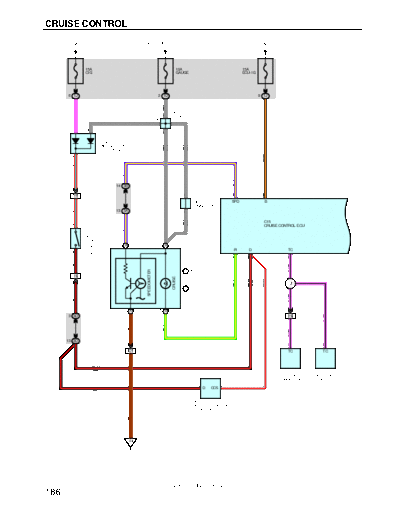
CRUISE CONTROL
FROM POWER SOURCE SYSTEM (SEE PAGE 52)
15A 10A 15A
CIG GAUGE ECU- IG
6 1J 2 1D 9 1J
GR
J17
JUNCTION
P
A CONNECTOR
GR A A
1 3
A
D12
DIODE
(PARK/NEUTRAL
(*2)
(*1)
GR
GR
POSITION SW)
B- O
2
R- L
V- Y
V- Y
14 3B
7 IH1 D 12 9
J18
JUNCTION SPD B
CONNECTOR
13 3A
R- L
D
(* 1)
GR
C15
2 CRUISE CONTROL ECU
V- Y
[PARK/NEUTRAL
D POSITION SW
POSITION SW]
11 A 9 A
PI D TC
P1
10
4 3 5
B- R
COMBINATION METER
P- B
SPEEDOMETER
C 9 B , C10 A
7 IH2
CRUISE
W- R
G- Y
B- R
(*2)
(*1)
I2
B- R
P- B
16 A 3 B
3 3D 18 IH2
P- B
G- Y
BR
P- B
13 3D
11 13
4 ID1 TC TC
B- R
(*2) D1 D3
DATA LINK DATA LINK
CONNECTOR 1 CONNECTOR 3
B- R 12 26
D CCS
(*1)
A29
ABS AND TRACTION ECU
(TRANSLATE ECU)
BR
IH
2001 SIENNA (EWD420U)
186
FROM POWER SOURCE SYSTEM (SEE PAGE 52)
E 9 B , E10 C
* 1 : W/ VSC
ENGINE CONTROL MODULE * 2 : W/O VSC
15A
E1 STOP
ELECTRONICALLY
CONTROLLED
TRANSMISSION
IDLO OD1 S2 S2 SOLENOID
25 B 24 B 1 C 10 7 1C
L- B
L- B
D
11 J13
L- B D
IH2 JUNCTION
CONNECTOR G- W
D
L- B
B- L
7 3B
L
13 IH1 G- B
G- W
W
18 3B
L- B
G- W
13 14 6 2 8 3 2
IDL OD ECT STP L
5 1R
S6
STOP LIGHT
C15 SW
CRUISE CONTROL ECU
4 1R
4 1
GND CCS MO MC G- W
16 10 15 7
R- G
R- Y
R- B
W
5
CCS
7 IK3 4 IK3 8 IK3
CRUISE
R- G
R- Y
R- B
RES/ACC
1 2 3
W- B
MO MC L
SET/
COAST
M
CANCEL
ECC GND
4 C13 C3 4
CRUISE CONTROL SW CRUISE CONTROL ACTUATOR
W- B
[COMB. SW]
W- B
10 3B 1 3B
3 IK3
W- B
10 3C 22 3C
W- B
W- B
IG
2001 SIENNA (EWD420U)
187
CRUISE CONTROL
SYSTEM OUTLINE
Current is applied at all times through the STOP fuse to TERMINAL 2 of the stop light SW.
With the ignition SW turned to on, current flows through the GAUGE fuse to TERMINAL (A) 9 of the cruise control indicator
light and the current through the ECU-IG fuse flows to TERMINAL 9 of the cruise control ECU.
When the ignition SW is on and the cruise SW is turned on, a signal is input from TERMINAL 5 of the cruise control SW to
TERMINAL 10 of the cruise control ECU. As a result, the cruise control ECU functions and the current flows from the
ECU-IG fuse to TERMINAL 9 of the cruise control ECU to TERMINAL 16 to GROUND, and the cruise control system is
ready for operation.
At the same time, the current through the GAUGE fuse flows to TERMINAL (A) 9 of the cruise control indicator light to
TERMINAL (B) 3 to TERMINAL 4 of the cruise control ECU to TERMINAL 16 to GROUND, which lights up the cruise control
indicator light, indicating that the cruise control is ready for operation.
1. SET OPERATION
When the cruise SW is turned on and the set SW is pushed with the vehicle speed within the set limit (Approx. 40 km/h, 25
mph to 200 km/h, 124 mph), a signal is input to TERMINAL 10 of the cruise control ECU, and the vehicle speed when the set
SW is released is memorized in the ECU as the set speed.
2. SET SPEED CONTROL
During cruise control driving, the ECU compares the set speed memorized in the ECU with the actual vehicle speed input
into TERMINAL 12 of the cruise control ECU from the speed sensor, and controls the cruise control actuator to maintain the
set speed.
When the actual speed is lower than the set speed, the ECU causes the current to the cruise control actuator to flow from
TERMINAL 15 of the cruise control ECU to TERMINAL 1 of the cruise control actuator to TERMINAL 2 to TERMINAL 7 of
the cruise control ECU. As a result, the motor in the cruise control actuator is rotated to open the throttle valve and pull the
throttle cable to increase the vehicle speed.
When the actual vehicle speed is higher than the set speed, the current to the cruise control actuator flows from TERMINAL
7 of the ECU to TERMINAL 2 of the cruise control actuator to TERMINAL 1 to TERMINAL 15 of the cruise control ECU.
This causes the motor in the cruise control actuator to rotate and close the throttle valve to return the throttle cable, thus
decrease the vehicle speed.
3. COAST CONTROL
During the cruise control driving, while the coast SW is turned on, the cruise control actuator returns the throttle cable to
close the throttle valve and decrease the driving speed. The vehicle speed when the coast SW is turned off is memorized,
and the vehicle continues at the new set speed.
4. ACCEL CONTROL
During cruise control driving, while the accel SW is turned on, the cruise control actuator pulls the throttle cable to open the
throttle valve and increase the driving speed.
The vehicle speed when the accel SW is turned off is memorized, and the vehicle continues at the new set speed.
5. RESUME CONTROL
Unless the vehicle speed falls below the minimum speed limit (Approx. 40 km/h, 25 mph) after canceling the set speed by
the cancel SW, pushing the resume SW will resume the speed which was set before cancellation.
6. MANUAL CANCEL MECHANISM
If any of the following operations occurs during cruise control operation, the magnetic clutch of the actuator turns off and the
motor rotates to close the throttle valve and the cruise control is released.
Placing the shift lever to a position except "D" position (Park/Neutral position SW except "D" position). "Signal is not input
to TERMINAL 3 of the ECU".
Depressing the brake pedal (Stop light SW on). "Signal input to TERMINAL 2 of the ECU".
Pushing the cancel switch (Cancel SW on). "Signal input to TERMINAL 10 of the ECU".
Pushing the cruise SW (Cruise SW off).
2001 SIENNA (EWD420U)
188
7. TAP-UP CONTROL FUNCTION
When the difference between the actual vehicle speed and the set speed is less than 5 km/h (3 mph), the set speed can be
increased 1.5 km/h (0.9 mph) each time by operation the RES/ACC SW quickly, within approx. 0.5 seconds.
8. TAP-DOWN CONTROL FUNCTION
When the difference between the actual vehicle speed and the set speed is less than 5 km/h (3 mph), the set speed can be
lowered 1.5 km/h (0.9 mph) each time by operating the SET/COAST SW quickly, within approx. 0.6 seconds.
9. AUTO CANCEL FUNCTION
A) If any of the following conditions are detected, the set vehicle speed memory is erased, and the cruise control is
released. In addition, the power indicator will blink until the cruise SW is turned on again, and the cruise SW will not
accept further operations unless the ignition SW is turned on again.
When current continues to flow to the motor inside the actuator, in the throttle valve "OPEN" direction.
The motor does not operate despite the motor drive signal being output.
B) If any of the following conditions are detected, the set vehicle speed memory is erased, and the cruise control is
released. In addition, the power indicator will blink until the cruise SW is turned on again, and the system can not be
operated until the cruise SW is turned on again.
Over current to transistor driving the motor or the magnetic clutch.
Open circuit in the magnetic clutch.
Momentary interruption of vehicle speed signal.
C) If any of the following conditions are detected, the set vehicle speed memory is erased, and the cruise control is
released. (Reset is accepted)
When the vehicle speed falls below the minimum speed limit, approx. 40 km/h (25 mph)
When the vehicle speed becomes - 16 km/h slower than the set speed.
10. AUTOMATIC TRANSAXLE CONTROL FUNCTION
In overdrive, if the vehicle speed becomes lower than the overdrive cut speed (Set speed minus approx. 4 km/h, 2.5 mph)
during cruise control operation, such as driving up a hill, the overdrive is released and the power is increased to prevent
reduction in the vehicle speed.
After releasing the overdrive, if the vehicle speed becomes higher than the overdrive return speed (Set speed minus
approx. 2 km/h, 1.2 mph), and the ECU judges by the signals from the actuator's potentiometer that the upward slope has
finished, the overdrive is resumed after.
During cruise control driving, the cruise control operation signal is output from the cruise control ECU to the engine control
module. Upon receiving this signal, the engine control module changes the shift pattern to normal.
To maintain smooth cruise control operation (on a downward slope etc.), the lock-up release of the transaxle when the
idling point of the throttle position is "ON" is forbidden.
SERVICE HINTS
C3 CRUISE CONTROL ACTUATOR
3-4 : Approx. 38.5
C13 CRUISE CONTROL SW [COMB. SW]
5-4 : Continuity with the CRUISE SW on
5-4 : Approx. 1540 with the CANCEL SW on
Approx. 240 with the RES/ACC SW on
Approx. 630 with the SET/COAST SW on
C15 CRUISE CONTROL ECU
9-GROUND : Approx. 12 volts with the ignition SW at ON position
12-GROUND : 4 pulses with 1 rotation of rotor shaft
10-GROUND : Approx. 1540 with the CANCEL SW on in the control SW
Approx. 630 with the SET/COAST SW on in the control SW
Approx. 240 with the RES/ACC SW on in the control SW
16-GROUND : Always continuity
2001 SIENNA (EWD420U)
189
CRUISE CONTROL
: PARTS LOCATION
Code See Page Code See Page Code See Page
A29 34 D1 32 J13 35
C3 32 D3 34 J17 35
C9 B 34 D12 34 J18 35
C10 A 34 E1 32 P1 33
C13 34 E9 B 34 S6 35
C15 34 E10 C 34
,,,
,,, : JUNCTION BLOCK AND WIRE HARNESS CONNECTOR
,,,
Code See Page Junction Block and Wire Harness (Connector Location)
1C
1D
22 Cowl Wire and Driver Side J/B No.1 (Lower Finish Panel)
No 1
1J
1R
3A
3B
26 Cowl Wire and J/B No 3 (Behind the Combination Meter)
No.3
3C
3D
: CONNECTOR JOINING WIRE HARNESS AND WIRE HARNESS
Code See Page Joining Wire Harness and Wire Harness (Connector Location)
ID1 42 Instrument Panel Wire and Cowl Wire (The Back Side of the Lower Finish Panel)
IH1
44 Engine Wire and Cowl Wire (Front Side of the Blower Motor)
IH2
IK3 44 Engine Room Main Wire and Cowl Wire (Right Cowl Side Panel)
: GROUND POINTS
Code See Page Ground Points Location
IG 42 Left Cowl Side Panel
IH 42 Right Instrument Panel Brace
: SPLICE POINTS
Code See Page Wire Harness with Splice Points Code See Page Wire Harness with Splice Points
I2 44 Cowl Wire
2001 SIENNA (EWD420U)
190
◦ Jabse Service Manual Search 2026 ◦ Jabse Pravopis ◦ onTap.bg ◦ Other service manual resources online : Fixya ◦ eServiceinfo