Service Manuals, User Guides, Schematic Diagrams or docs for : . Rare and Ancient Equipment Ericsson Mobile Phones ERICSSON GF786, GF788, GF788E ERICSSON GF786, GF788, GF788E
<< Back | HomeMost service manuals and schematics are PDF files, so You will need Adobre Acrobat Reader to view : Acrobat Download Some of the files are DjVu format. Readers and resources available here : DjVu Resources
For the compressed files, most common are zip and rar. Please, extract files with Your favorite compression software ( WinZip, WinRAR ... ) before viewing. If a document has multiple parts, You should download all, before extracting.
Good luck. Repair on Your own risk. Make sure You know what You are doing.
Image preview - the first page of the document
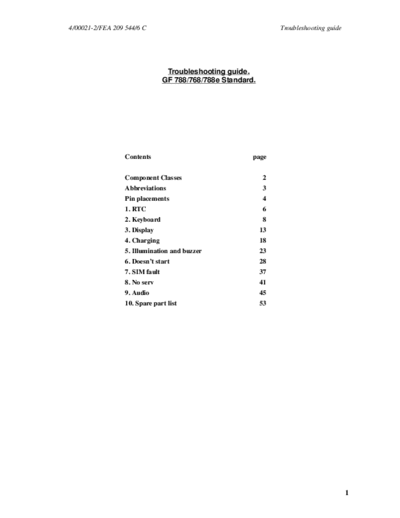
>> Download ERICSSON GF786, GF788, GF788E documenatation <<
Text preview - extract from the document
4/00021-2/FEA 209 544/6 C                                         Troubleshooting guide


                                  Troubleshooting guide.
                                 GF 788/768/788e Standard.


                  Contents                               page


                  Component Classes                           2
                  Abbreviations                               3
                  Pin placements                              4
                  1. RTC                                      6
                  2. Keyboard                                 8
                  3. Display                                 13
                  4. Charging                                18
                  5. Illumination and buzzer                 23
                  6. Doesn't start                           28
                  7. SIM fault                               37
                  8. No serv                                 41
                  9. Audio                                   45
                  10. Spare part list                        53


                                                                                          1
Troubleshooting guide                                                         4/00021-2/FEA 209 544/6 C


                                         Component classes.

All the components in the phone are divided into classes and after every component in the troubleshooting guide
you have a class written. The components are divided into four classes: A, B, C and D.The class of the component
depends on how much of the phone's performance is affected when replacing it.

Class A and B: A test call towards the "real" net (not only towards a GSM test instrument) and run it through
               the normal tests is enough to verify the functionality since the performance of the phone is only
               slightly affected.
Class C:       Since the tolerances of the component are so great it can substantially affect the performance of
               the phone you need to calibrate it at station level after replacing the component.
Class D:       Class D components need to be calibrated at board level using very advanced equipment and
               may therefore not be replaced.


2
4/00021-2/FEA 209 544/6 C                                                            Troubleshooting guide


                                              Abbreviations.

A:   The power module at some phones.
B:   Crystal.
C:   Capacitor.
D:   Digital circuit.
F:   Over voltage protection.
G:   VCO.
H:   Buzzer, LED, pads for display.
J:   Connector.
L:   Coil.
N:   Analogue circuit.
R:   Resistor.
S:   Keyboard pads.
U:   BALUN. A circuit that converts a signal from balanced to unbalanced or the opposite.
V:   Transistor or diode.
X:   Contact surface at the circuit board.
Z:   Filter.

AGND:    Ground for analogue signals.
DCIO:    DC voltage used for charging the battery through the system connector.
DCON:    Logical signal from the processor that keeps the phone running after you've released the On/Off
         key.
EXTAUD: Input signal at the system connector that the processor uses to determine if there's any external
         audio equipment attached.
EXTAUDI: The same signal as the EXTAUD signal but at the processor side.
GND:     Ground.
LED3K:   Logical signal used to activate the background illumination.
ONSRQ:   Voltage from the On/Off key that starts the phone.
PORTHF: Input signal at the system connector that the processor uses to determine if there's any handsfree
         equipment attached.
PHF1:    The same signal as PORTHF but at the processor side.
REGON:   Logical signal that activates the voltage regulators.
RTC:     Real time clock. The clock that keeps track of time and date.
SIMCLK: Clock signal from the processor used for communications with the SIM.
SIMDAT:  Data signal from the processor used for communications with the SIM.
SIMRST:  Reset signal from the processor used for communications with the SIM.
SIMVCC: Feed voltage for the SIM.
SWDC:    Switched VBATT.
VANA:    DC voltage for the analogue part of the logic (N800).
VBATT:   Battery voltage.
VDIG:    DC voltage for the processor and memory.
VDSP:    DC voltage for the DSP (Digital Signal Processor).
VLCD:    DC voltage for the display that controls the contrast.
VRAD:    DC voltage for the radio part except the synthesizer.
VRPAD:   DC voltage for the radio part in D600 (also used for the top diode and the buzzer).
VRTC:    DC voltage for the real time clock.
VSIMPAD: VDIG voltage that has been switched up to 5V used for SIM.
VVCO:    DC voltage for the synthesizer.

I2C:           Two line serial communications standard using one clock and one data line.
LO:            Local oscillator.
PWM:           Pulse width modulation.


                                                                                                             3
Troubleshooting guide                                                 4/00021-2/FEA 209 544/6 C


                                        Pin placements


    Single diode (PIN diode).       Electrolytic capacitor.


    Double diode or single trans-   Five pin circuit (usually volt-     Double transistor.
               stor.                       age regulator).


          Eight pin circuit.              688 VCO circuit                788 VCO circuit


         Sixteen pin circuit             Twenty pin circuit                  Crystal


4
4/00021-2/FEA 209 544/6 C          Troubleshooting guide


    N800                    D900


    D600


    D620                    D610


                                                           5
Troubleshooting guide                                                              4/00021-2/FEA 209 544/6 C


1. RTC
1.1    Find the fault.

Start the phone with a SIM-card and a fully charged battery inserted. Set the correct time. Remove the battery and
reinsert it after a minute.
◦ Jabse Service Manual Search 2026 ◦ Jabse Pravopis ◦ onTap.bg ◦ Other service manual resources online : Fixya ◦ eServiceinfo